
Creative Lives: Gail Gosschalk, illustrator
In the first of my new series, where I interview creatives about balancing work and personal projects, I talk creative rituals, ego and self sabotage with illustrator and nomad Gail Gosschalk.

Gail Gosschalk is an illustrator and strategist, originally from London, but now based in Tunis, by way of many other beautiful places. I actually have her Harissa print hanging in my kitchen. We first met when Gail joined my website copywriting programme, Write Your Site Right, and from there a very weird, often Shakira-meme-based friendship has blossomed.
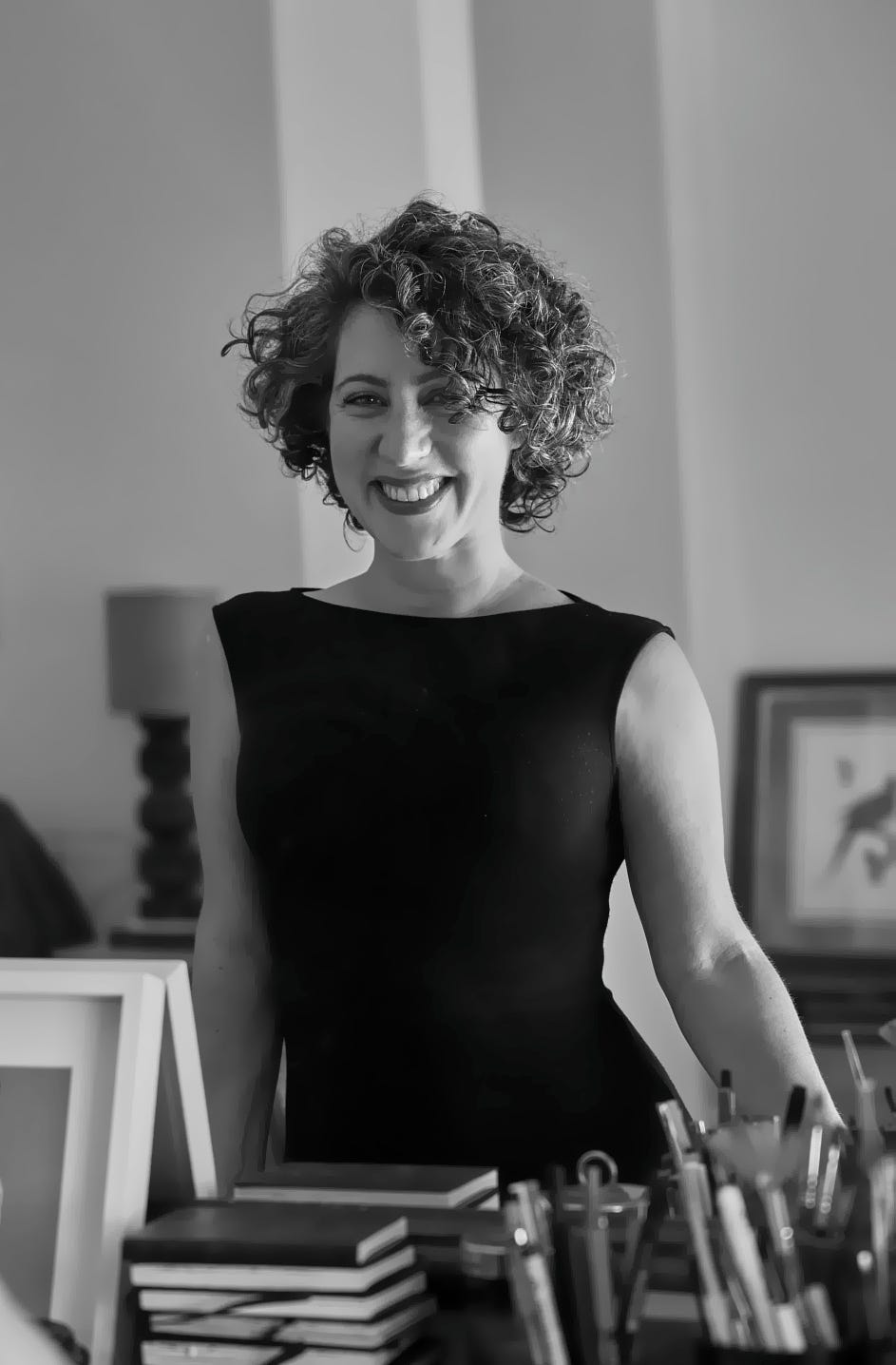
I knew I wanted to run a series interviewing creatives and Gail was a no-brainer first choice. So, when I first set up this interview, I did so in full fan-girl mode – thinking that Gail had all this creative life stuff figured out. Well, small spoiler here: she doesn’t. And, in a way, that makes the interview even better than I anticipated. What followed was a deliciously raw and honest conversation about self-censorship, creative guilt and the urge to sabotage and critique the opportunities we’ve wanted all our lives. Turns out, we’re all (predicably) as bad as each other.


Emma: What does your creative practice look like outside of work?
Gail: The thing that makes me the happiest is observational drawing – I love meeting people and the connections that drawing creates with them. Even when you don't necessarily have language in common, [editor’s note, Gail currently lives in Tunis], you can still build deep connections through drawing. So I used to be very good at spending a lot of time just following my feet around cities, meeting people, exploring and drawing whatever my intuition would stop me at. Work has felt heavy and I've stopped making time for that at the moment, but that is absolutely the healthiest and happiest state for me. Trying to remember to get out of the mental production wheel and just enjoy the moment. I go out and I don't really know what I’m going to do, I just go out and provoke the day.
E: Are there specific things you do – like go to a cafe? How does it work as a creative ritual?
G: I really follow natural light. So that will influence where I'm going to stop, and the drawing conditions as well. I like just getting lost wandering around. And it’s always in the mornings, because that's when I feel like I should be productive – and when I don't feel like that, I'll look for coffee somewhere and then things just start to roll.
The people here are amazing – often I will end up sitting next to somebody who's been immobile for 40 minutes. For me, they've understood happiness in a way that we haven’t. There's so much we have to unlearn coming from an environment where progress needs to be linear, where we need to perform, where we need to have noticeable deliverables. These guys, there's a kind of contentment that you see in their body language, that you see in their relationship with the sea, that I just find so deep. And so I draw something that brings me towards that, something that inspires and triggers curiosity. And this is why I draw. That moment becomes indelible in my memory because I really engraved it: the people I spoke to, the patience of the drawing. My soul is now going to hold on to that moment forever.
E: What you're describing sounds a lot like a flow state derived from presence and an awareness of simple things. Do you manage to slip into that, or do you feel you're constantly twitching to reach for your phone?
G: I think there's a real kind of mental pollution. I sometimes find myself drawing for Instagram. Going out and drawing for the sake of drawing is something I have found harder to justify recently, not having a financial return on it. But the minute I start walking out and organically meet people, and see their reactions to what I’m drawing, it validates the whole reason behind why I'm doing it. You've got people saying, “Oh, I completely forgot how special that was,” or, “We see this every day, it's so lovely to see wonder from somebody else's eyes.” So I've felt guilty about it, but I realised it’s the very point of why I draw and so I need to fight to get back and simply go for it.
E: What are some of the telltale signs that indicate you might be slipping into the danger zone, where you’re overworking and burning yourself out creatively?
G: I've realised that I start to detach, basically. I don't sleep and my brain doesn't switch off because I'm thinking about work. And then I wake up and feel completely overwhelmed. That's when it gets really bad. But the signs that I should catch before that happens are when I feel like I can't be in the present moment with my kids, or go away for the weekend because I have this feeling of an obligation to work when I've already worked my arse off all week. It’s like I'm in a helicopter, watching myself badly run my life.


E: For me, the biggest warning sign is that I’m not able to be present even when I so desperately want to be. I'm constantly being mentally dragged away by these things that don't matter. I use TV and social media to numb myself out, even though I know the beneficial things, like being in nature, going and doing some exercise, making myself create something, are the things that help.
G: I find this kind of mental resistance as well. Often when I'm in deep in detachment mode and I'm super stressed and my husband's saying, “Why don't you go out? Why don't you just go out with some girlfriends tonight? Why don't you?” He looks after me and I resist it. Because I feel like this tension I have is so highly strung, that if I sit down for a second, I'm going to fall apart. And I won't be able to pick myself up again. It's kind of like, you know, when you're depressed, and you can't help yourself? It's like this inertia – I feel like burning out is the same. You naturally begin to fuel it, by ignoring the absolute screaming needs that your body and your soul have.
E: What other creative strings do you have to your bow?
Everything you can do. I love sewing. I love embroidering. I studied fashion design and I love making clothes for my kids. Never finish anything, though. I'm making a carpet, which I will also never finish. I really, really love cooking.
I love making, basically. Painting walls, lampshades, anything. I realise I'm actually almost happier embroidering than drawing sometimes, just because it really is making for making's sake. And then when I see the little cushion that I’ve embroidered, I remember the well-being I felt. I have to be doing something with my hands. Because my work is so hyper-controlled, anally perfectionist, there’s something so much freer in my approach to cooking, for example. It is completely approximative and sensory. Or painting the walls – I never know what I'm going to do and it just happens. I'm free in a way that I would never be in front of paper and I just don't know how to get to that point with my creative process in 2D.
My husband said something that really helped me after my exhibition [Gail recently exhibited in Tunisia], which of course I wasn't satisfied with. But it was beautiful; it lasted a week and it was really, really well received. It sold well. On paper, I should have been happy. But I knew that it was so far from – and I don't mean this in an arrogant way – what I was capable of, or what I wanted to say. The minute it was over, he looked at me, like do not go there. Don't analyse it, don't think about it, don't criticise it. You're not allowed to touch the memory of what's happened for six months because you'll see that when that time passes you'll be more gentle with yourself. And that was really good advice because he's right. I did my best with what I had and it was a block and I'll build on it for the next time. I actually really hope that isn't the next time now.
E: What do you think the block was? I'm really interested in at what point of the process you went from it feeling like a super exciting opportunity to feeling like a drag and something you were no longer fully invested in or proud of?
G: My ego. I had started with one voice, it went to five, by the end there were 50 voices completely sabotaging every single good idea that I had. When it all started, and the gallery called me up and said, “Do you want the show?” I knew it was the right time. I'd been avoiding it for years – the last show I had in Jerusalem was 10 years ago. But I thought, this is with people who make me feel very safe. The space is amazing. Yalla. So I said yes without even thinking about it. And I knew that it would be a really good challenge.
A few days later, we went out for dinner, and I could see what I wanted to do with the space. It was really joyful. But, bit by bit, this complete auto-sabotage killed off every road I could see myself wanting to explore. It made me feel that I just don't know how to be creative in a world like this. And so by the end of it, they were like, "Girl, you've got so much positive energy. What is going on? You should be enjoying this process." I feel like it's my kind of moral responsibility to respond to the times. Then you've got people saying, "It's not your responsibility. You're an artist, you're free. You don't have to take the weight of things on your shoulders. You're allowed the space that you're so conscious of taking from; you're not taking it from others. There's room for everyone. You're allowed to deal with topics, even if they're not yours, because that's what artists do.” It was completely in my own head, and it was just ego. And if someone else had been telling me all the nonsense I was saying, I would have said the same thing. “Be free, go for it, it's going to be amazing."
So I ended up doing miniatures. In a hundred-square-metre gallery. My work was tiny. I had to supply magnifying glasses. It was kind of cute… but also sadistic. Like I was punishing myself for not finding the “right” idea with integrity. So instead, I pushed my technical skills to the limit. The exhibition was a success, but getting there was a shitshow.
E: So much of what you said just sounds like internal policing of everything. I struggle with it as well. Those voices that say it doesn't matter what you think because there's enough voices like yours, so you should shut up or give other people a voice. So you end up self-censoring the stuff that you really want to talk about because it feels unsafe.
When you're exhibiting or sharing anything that you've done, is there still a person in your head that you sometimes visualise saying negative, stupid things?
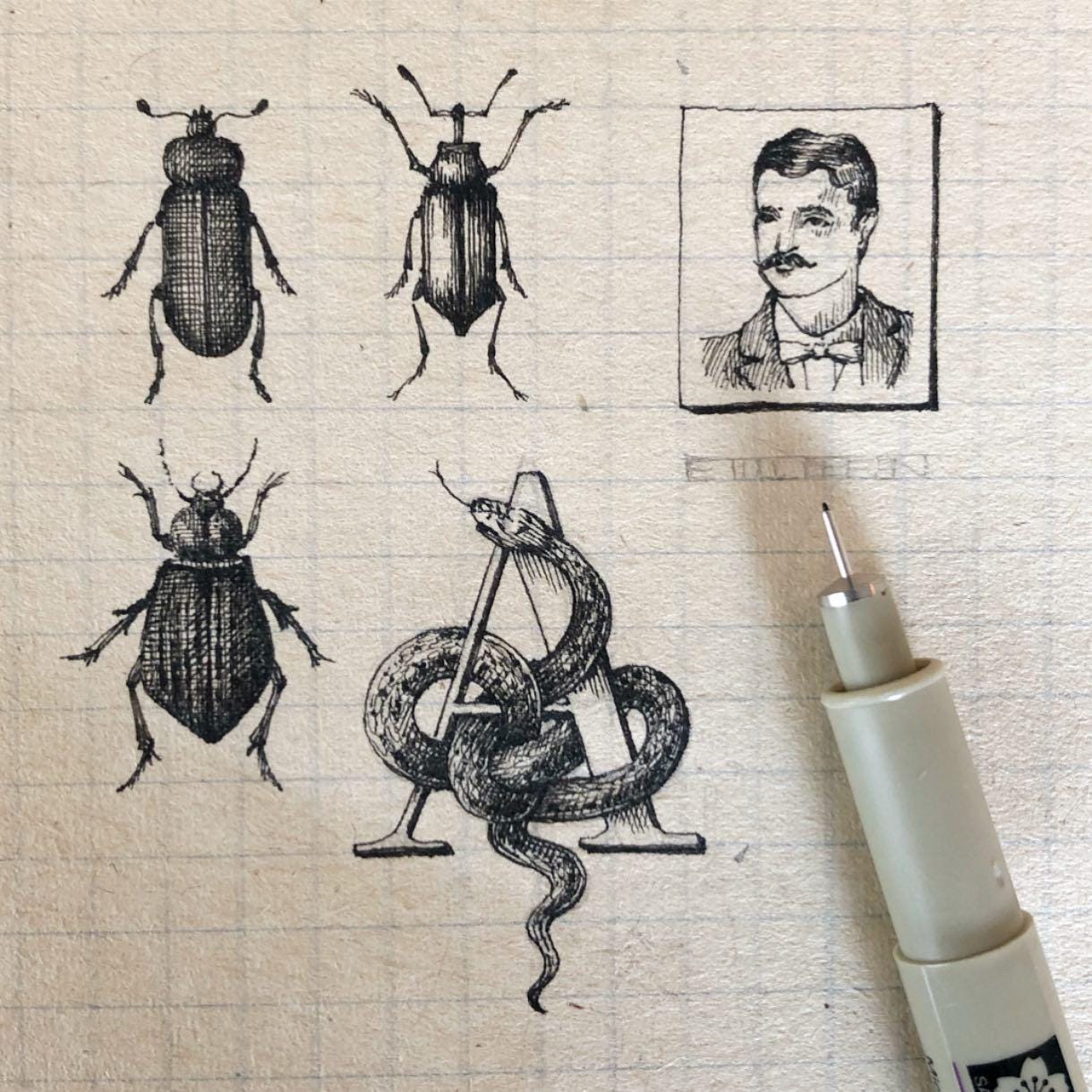
G: I have a whole coach-load of specific faces – it’s about not proving them right with the criticisms that I feel that they have of what I represent. The biggest voice that criticises you is always going to be your own insecurities. I thought I was going to be a fine artist. I had a very, very influential art teacher. He's one of the voices in my head that I've never put to peace. I went to art school, did a foundation, wanted to go into drawing and they said actually the way that you work, the way you collate information would be really good for a trend agency: you're a conceptual researcher, you should go into fashion. My happiest ever possible place to be is in a library, drawing from old books, from dictionaries and encyclopedias. That's absolutely my favourite thing in the world. I transcribe visuals that already exist, but I’m collating and putting things together. I was really born in the wrong century. I should have just illustrated encyclopedias like that.
So, my initial plan was to do fashion. And then on the first day of work in a trend agency, I said, yeah, no, definitely not for me. Did six months and then went freelance for illustration.
E: So you tried the sanitised, sensible, boxed-in version of supposedly what your skill set fits in?
G: Well, I listened to what they said a good career would be because I definitely had kickback from my family about doing fine art. Despite my mum being an antique dealer – she worked in Philips and Sotheby's – we were brought up to appreciate the arts but we were definitely not supposed to be one of the makers. They were a little bit worried about that also because I'm not a finisher so they were worried that I was going to start and then not have qualifications. But also I think they didn't fight it because, character-wise, I would have just done it on principle. And it went really well actually. I went freelance when I was 24 and I got Hermes as a first client when I was 25. They kind of had to shut up about it.


E: When you say that you're a serial unfinisher of things what do you think is the block? Is it shiny-object, ADHD sort of thing, or is there a deeper block there that doesn't allow you to finish the things that are not paid for by clients?
G: I think it's got nothing to do with being paid for or not paid. The minute I'm given a brief, like literally within the first five seconds, I've got it. My inner eye can see it and I am completely turned on by how to translate that. Because you have such a deep idea of the kind of emotional impact that you want. I love the human interaction and the satisfaction of getting there when the client didn't even know where we're gonna get to. But once I've understood what I'm doing, like how to do it, the actual production of it is completely arbitrary. And so the actual realisation, the closing, is often where I'm kind of outdone. I outdo myself because, more and more, my work relies on the computer for the finishing and I’m technically outdone.
So often, that's why finishing something gives me blocks. Because I'm completely distracted by a new project – I've always got 15 on at the same time.
With my personal work, I do allow myself to drop off whenever the inspiration is gone, because I know it will come back. And sometimes it's like 10 years later. And I’ll get a ping, like right here, right now, this is the day that I'm going to finish that thing that kept me awake. I've got paintings that I've started again and again and again. Sometimes things just elude you, the conclusion: that little thing that gives it that little kick to give it sense. I know it all looks nice and pretty but it's missing that something. And then it comes back months or years later and it's like the final puzzle piece needs to drop in, but you need to just go away and live life a little bit for that to happen.
You can view Gail’s work on her website, and I strongly recommend following her on Instagram for a large hit of creative inspo.
OMG THANK YOU for this gorgeous piece and for introducing me to the magic of Gail Gosschalk whose art I also need on my walls. Reading this has made me realise how out of flow I've been lately and I need to come back to that xo